


Key takeaways: Break one anchor asset into a Content Bank of articles, social posts, carousels, videos and sales tools. Use a content repurposing strategy and employee advocacy to distribute those assets and support a 90-day, multichannel campaign. This allows you to reach buyers throughout their research process.
In the last Expert-Led Content Engine article, we introduced the Two-Touchpoint Workflow, a structured approach to protecting your experts’ time. By limiting their involvement to one input session and one accuracy review, you remove the burden of content creation while producing a high-value anchor asset such as a report, white paper, or keynote presentation.
One strong asset isn't enough
Many B2B marketing teams invest heavily in a single report, white paper or keynote presentation and then fall into the post-and-forget trap. A strong content repurposing strategy changes that. Instead of treating an anchor asset as a finished product, leading teams treat it as the starting point for a Content Bank that fuels ongoing thought leadership.

A content repurposing strategy turns one core asset into multiple formats such as articles, social posts, videos, carousels and sales tools. A Content Bank is the structured system that organizes those assets into an ongoing stream of content across channels.
Why a Content Bank and employee advocacy work together
Creating great thought leadership content takes effort, so don’t let your best pieces sit around. A Content Bank ensures that work continues to generate value.
But how you distribute that Content Bank material matters just as much as what’s in it. Featuring your experts transforms standard marketing into a powerful employee advocacy and “social selling” engine.
When experts share content directly, it reaches buyers in a credible context:
- No “corporate filters”: Buyers trust people more than companies.
- Consistent presence on LinkedIn: It capitalizes on the social selling shift. LinkedIn is your primary sales floor for relationship-building.
- “Warm” expertise: B2B buyers crave guidance and ignore sales pitches. Insight-led posts open conversations before outreach.
Here’s the step-by-step shortcut to building a multichannel Content Bank and how to amplify the pieces:
Step 1: Select the right anchor asset
Not every piece of content is worth repurposing. And not every piece deserves to be. Start with an asset that tackles core business problems your audience deeply cares about. Look for content that includes:
- Clear data points
- Strong points of view
- Practical examples
For example, DHR Global builds its annual global Workforce Trends Report around issues that affect executive teams, including employee engagement, burnout and artificial intelligence (AI) adoption. Leadership alignment at the outset ensures the content remains relevant and valuable across multiple formats.
Step 2: Build the Content Bank
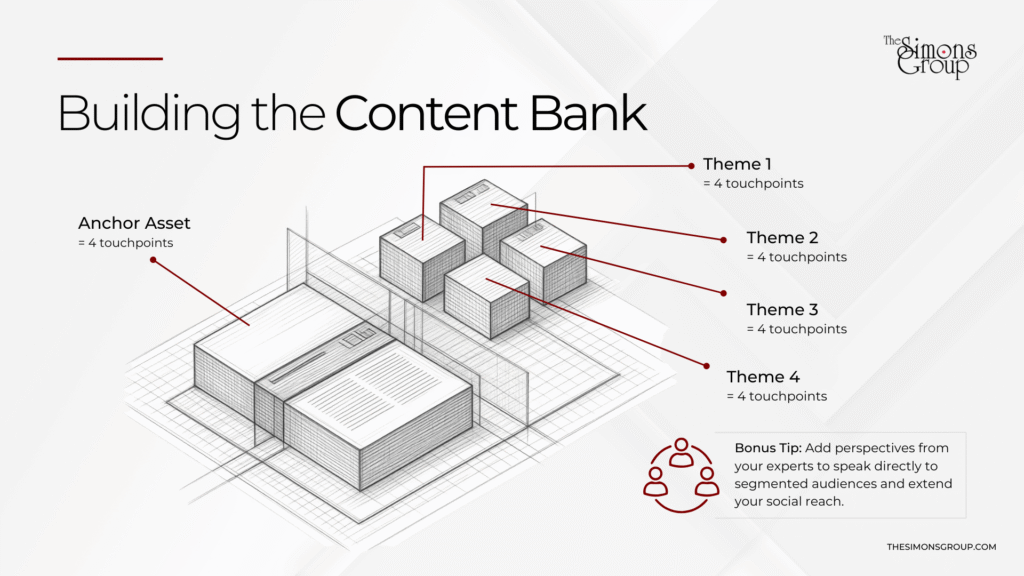
This is where a content repurposing strategy becomes practical, breaking one asset into distinct themes, perspectives and formats.
DHR Global’s Workforce Trends Report can produce multiple assets:
- Full report
- Theme 1 (e.g., The New Dynamics of Employee Engagement)
- Theme 2 (e.g., Burnout in the Workplace)
- Theme 3 (e.g., AI and the Workforce)
- Theme 4 (e.g., The Leadership Test Behind Return to Office)
To personalize each theme, DHR includes four to six partner perspectives. This allows the content to address different regions, industries and service lines while maintaining a unified narrative.
Step 3: Package content for expert sharing
Your experts should spend their time applying their judgment and perspectives instead of creating content. Give them prebuilt assets they can share quickly:
- Prewritten LinkedIn posts
- Graphics and carousels
- Short-form video clips
- Email copy for direct outreach
DHR uses an employee advocacy platform to distribute approved content to partners. With a few clicks, partners can share thought leadership that builds immediate trust and connects with buyers.
You can track performance through engagement data. The messaging stays consistent, your firm’s thought leadership stays visible and your experts stay focused on billable work.
Use a staggered release schedule
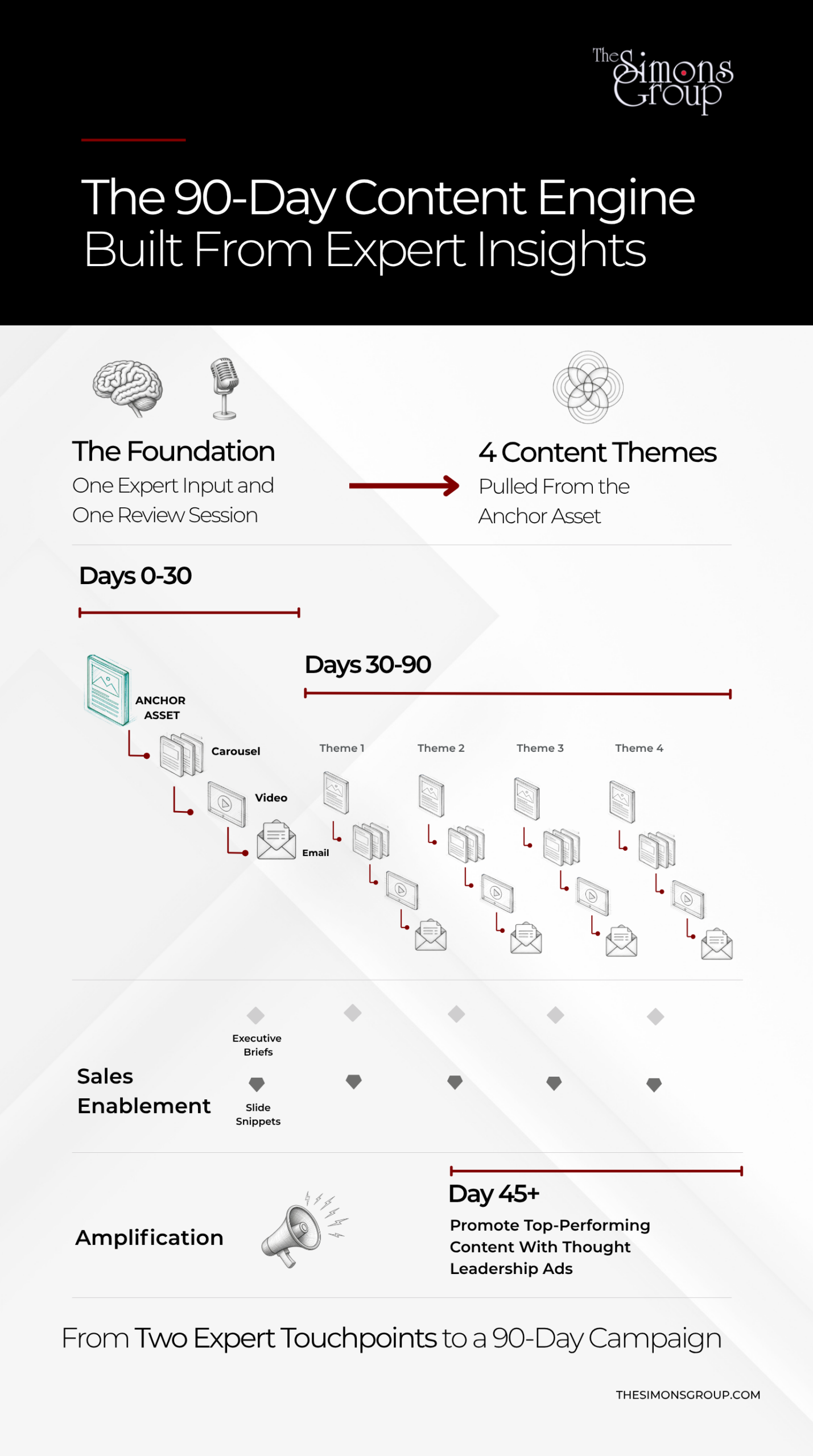
At DHR, the team uses a staggered release schedule to extend the life of each asset. This structured cadence turns a Content Bank into a content repurposing strategy rather than a one-time campaign:
- Release 1 (Article): When the article goes live, partners receive the link and a static graphic to share on LinkedIn.
- Release 2 (Carousel): About four weeks later, partners reshare the article on LinkedIn, using a carousel graphic designed to boost engagement and click-throughs.
- Release 3 (Video): About four weeks after that, partners reshare the article again using a short video graphic geared toward in-feed attention.
- Email distribution: Alongside the LinkedIn posts, partners receive prewritten email copy they can use to share the article directly with their networks.
The multiplier effect: DHR takes those five pieces of content (the report plus four themed articles) and runs them through a three-release social and email cadence to create 15 distinct touchpoints from a single report.
The messaging stays consistent, the firm’s partner insights and thought leadership show up across client and prospect feeds and inboxes, and experts stay focused on billable work.
Step 4: Convert content into sales tools
Thought leadership shouldn’t just live on social media; it needs to survive into the sales cycle. Surprisingly, many teams produce content without aligning it to sales conversations. That gap limits its usefulness.
A content repurposing strategy helps bridge that gap by translating your report into practical, sales-ready materials. A well-rounded Content Bank can include:
- Executive briefs: One-page summaries that distill key insights and implications, giving teams a concise way to support leadership discussions and decision-making
- Boardroom summaries: Polished handouts for C-suite audiences
- Slide snippets: Data points or quotes for pitch decks
Step 5: Amplify what works (and put paid behind it)
After a few weeks of partner and expert activity through the advocacy platform, look closely at what’s gaining traction. Identify which snippets, videos and emails are resonating with your audience.
One example is to take the partner posts on LinkedIn that are already getting engagement and run them as Thought Leader Ads. This ties posts to partners rather than company pages and reaches people beyond the partners’ immediate networks.
A smart content repurposing strategy extends the life and ROI of your core assets. It turns one piece of research into a Content Bank that keeps your firm visible and gives your partners tools for business development long after the initial launch.
Frequently asked questions
A content repurposing strategy defines how a team breaks one core asset into multiple formats — such as articles, social posts, videos, carousels and sales tools — and releases them over time to stay in front of buyers.
A B2B Content Bank is the system that marketing teams use to store, organize and distribute assets as part of a content repurposing strategy.
Yes. AI can extract and organize content. Editors should review all assets to ensure accuracy and maintain voice.
B2B buying involves multiple interactions. Sales-ready materials give teams the content they can use at each stage of the process.
What comes next in the series
You’ve planned your themes, captured expert insights and distributed the content across channels. The next question is the one every leadership team asks:
How do you know it’s working?
In the next article, we’ll focus on measurement and how to move beyond vanity metrics to track ROI and pipeline influence from your expert-led content.