


Key takeaways: The best B2B case studies help prospects picture what your company could accomplish for them. When customers share challenges and successes that hit close to home, buyers have a reason to take the next step. See how five companies make that connection, then follow our 12-step process to create your own case studies.
You’ve landed a great customer success story. The client loves your work, the results are impressive and you’ve got a complimentary testimonial. You create the content, publish it and hope prospective buyers contact you. But a lot is riding on how you tell that story.
The details you choose, the customer’s perspective and the way you present the results influence whether prospects recognize their own challenges and see your company as a potential solution. A case study that reads like a company victory lap may leave them wondering how any of it applies to their businesses.
The five B2B case study examples below show how companies use different storytelling techniques to hook prospective buyers. You’ll also find 12 steps to help you create your own customer stories.
Momentum WORK had just five weeks to set up a fulfillment warehouse for its largest contract, with seven shipping containers already on their way and no experience running an operation of that kind. The logistics predicament makes a compelling story.

The nonprofit, which provides employment opportunities for people who have developmental disabilities, needed to receive 1.72 million books and distribute them to 21 regional centers. Fulfill.com reports that Momentum WORK met its deadline and projects $388,900 in contract revenue.
The story then follows consultant Greg Airel as he helps the organization establish warehouse procedures, train employees, implement inventory software and develop a pricing structure that could generate revenue beyond operating costs.

One of the case study’s highlights is a before-and-after table that shows the changes in Momentum WORK’s pricing, warehouse operations and order processing. It also includes financial projections, giving readers a snapshot of the operational improvements and anticipated business benefits.
What you can learn from this and do:
- Open with an urgent challenge, then explain the obstacles the customer had to overcome.
- Use before-and-after tables to show improvements across several areas so prospects can understand the customer’s progress quickly.
- Connect operational improvements to financial outcomes to make business benefits clear.
What they could have done better:
- Let the customer tell the story: Judy Linares offers useful insights into Momentum WORK’s challenges and the consultant’s contributions, but Fulfill.com narrates most of the account. Additional firsthand observations about decisions and obstacles during the five-week launch would reveal how the team handled the pressure.
- Avoid generic headings: Generic headings such as “The Client,” “The Challenge,” and “The Results” make it hard for readers and AI search tools to find relevant information.
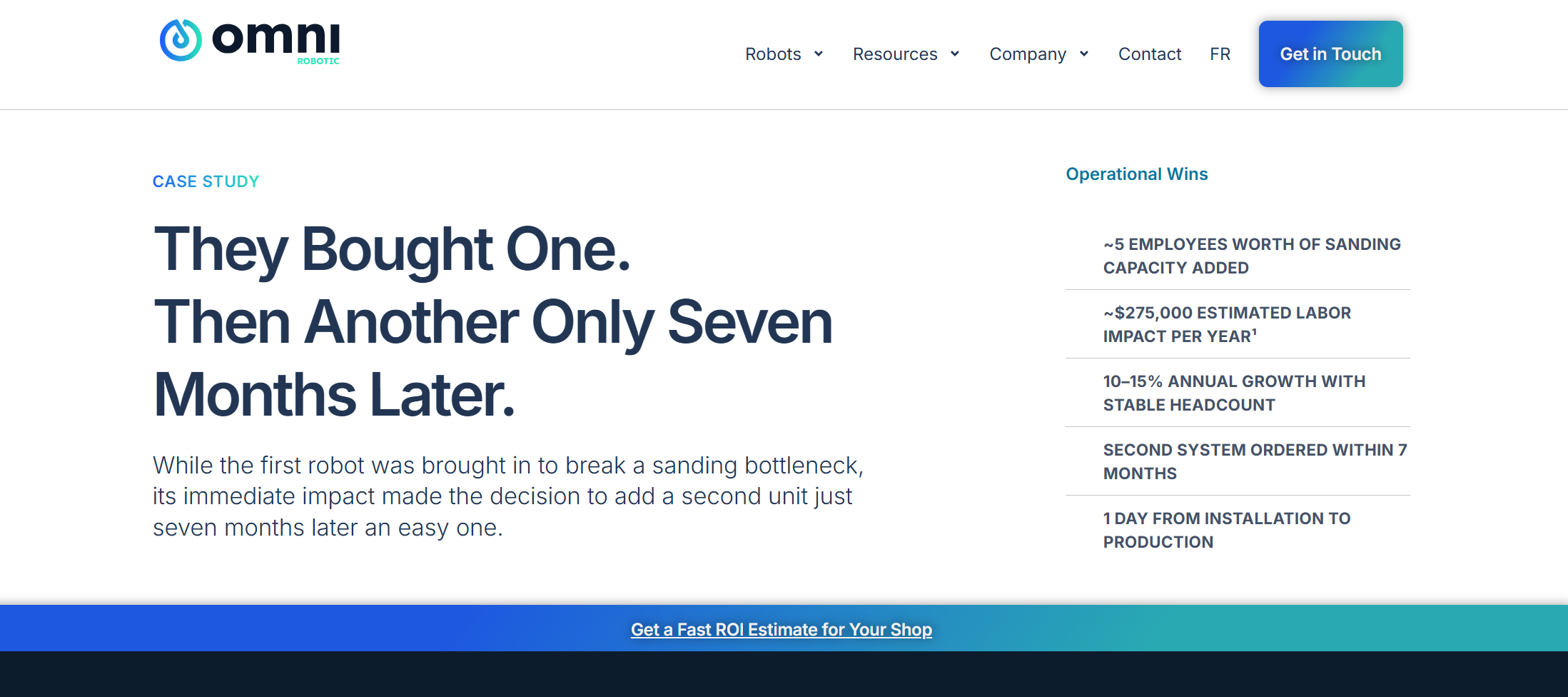
Buying a second robotic sanding system just seven months after installing the first says plenty about a customer’s satisfaction. That’s how Omnirobotic grabs readers’ attention in its case study about Cabinet Creations and Design, a manufacturer that was struggling to meet demand.
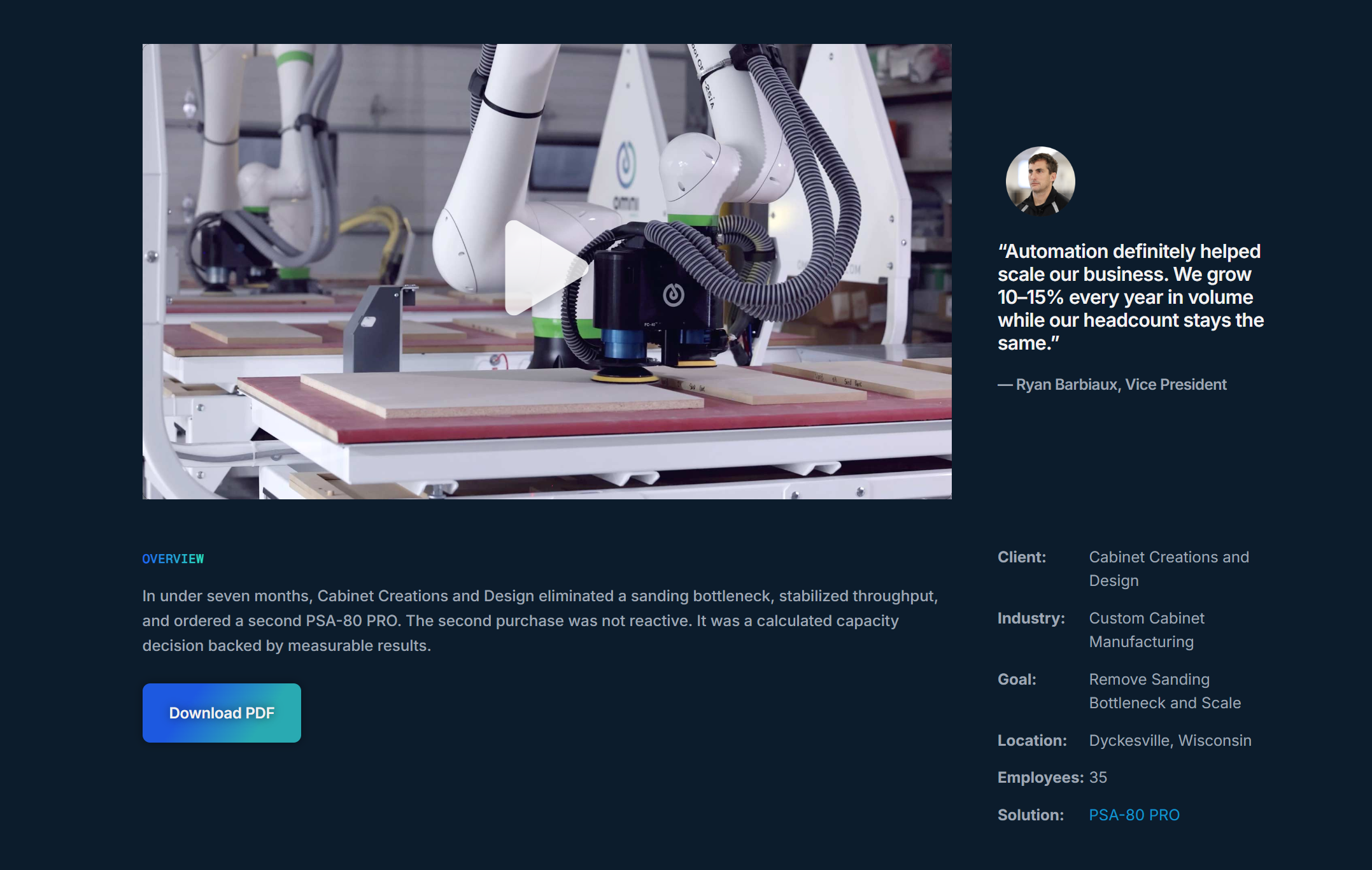
While the opening features strong results, the visuals give this story another dimension. An embedded video and photos of the robotic sanding equipment help prospects picture the production process and understand why the company invested in automation.
Production employee Trent Jandrin also describes how he can leave the equipment running while attending to other tasks, giving readers a firsthand account of how automation changed his daily work.
What you can learn from this and do:
- Use video to demonstrate equipment in action or show employees explaining processes that may be difficult to communicate through copy alone.
- Include photos that give readers useful context, such as the production floor, equipment placement or employees performing specific tasks.
What they could have done better:
- Show a direct visual comparison: The photos show the robotic equipment, but a side-by-side video or photo sequence of manual and automated sanding would help prospects see the difference in the production process.
- Cut the promotional language: Phrases such as “growth multiplier,” “driver of growth” and “value-added work” sound like marketing jargon. The production figures, employee comments and visuals provide concrete evidence of the equipment’s benefits.
A patient called 18 times in one week to confirm an appointment. A Renown Health employee noticed the patient had a referral to memory care and contacted her health care provider. The provider discovered that the patient’s condition was worsening and adjusted her care plan.
That incident is a focal point in this case study, which explains how Slalom helped the health system improve patient access to care.
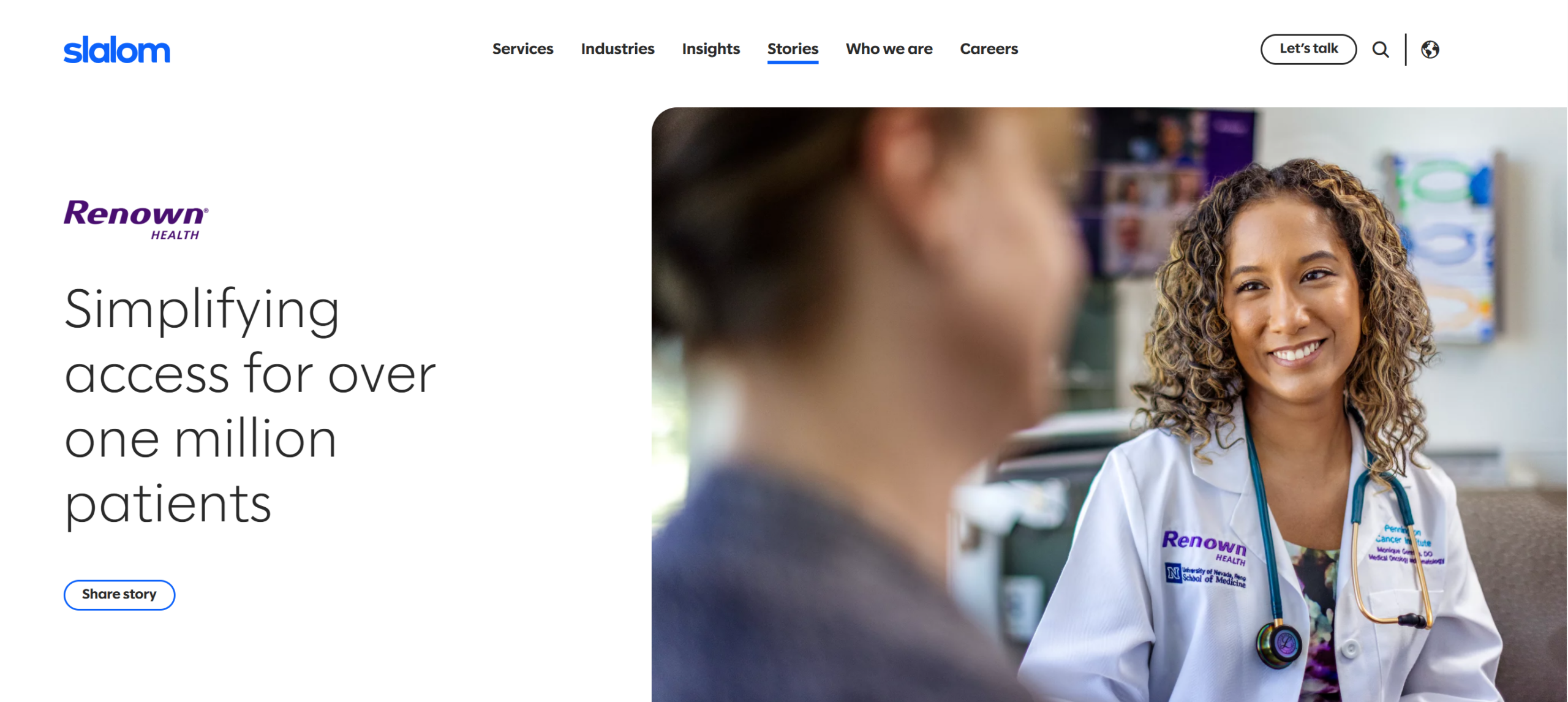
The story opens with a 35% year-over-year increase in new patient appointments, then describes the problems that frustrated patients and employees. Renown’s previous phone system included 19 automated systems and more than 20,000 routing rules.
Slalom then describes its investigation into patient experiences and employee workflows, followed by changes to the contact center. The incident illustrates what was at stake for patients.

The case study also reports improvements in patient-reported access and timely follow-ups, along with a high rating for ease of scheduling.
What you can learn from this and do:
- Use a specific incident, such as the patient’s 18 calls in one week, to show the urgency and human consequences of a customer’s problem.
- Connect operational results to the customer’s mission, such as helping a health system give patients timely access to care.
What they could have done better:
- Move the detailed results to the top of the page: The 35% increase in new patient appointments is near the top, but readers must scroll through much of the story to find the other three outcomes. Presenting all four results in the opening summary would make the information accessible to readers and AI search tools.
ECI Software Solutions opens its case study about ASH Industries, an injection molding manufacturer, with an estimated $1.5 million in annual savings, a 20% increase in machine utilization and a 10% reduction in unplanned downtime.
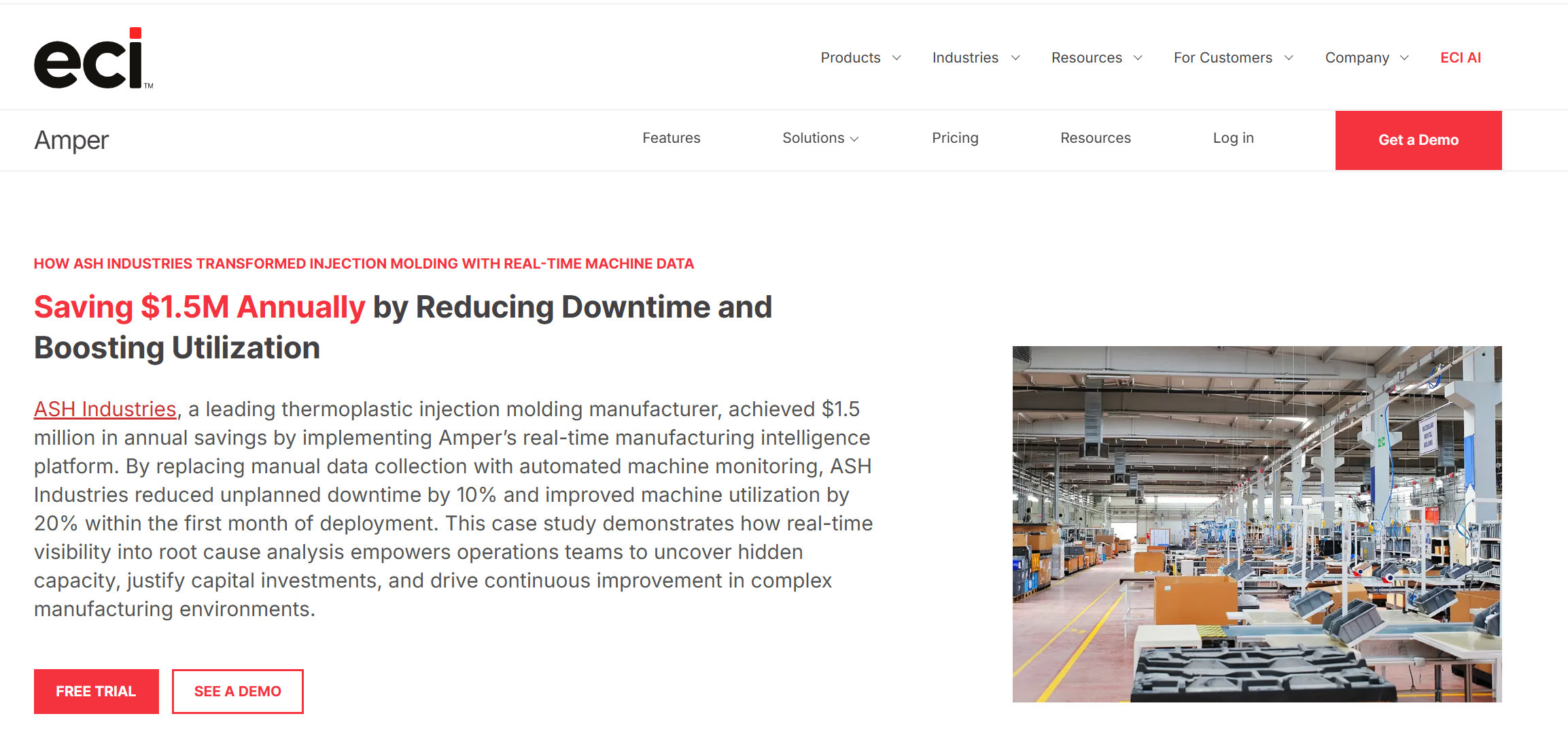
The story explains how ASH Industries replaced manual recordkeeping with automated monitoring, beginning with a three-machine pilot before expanding the system throughout its facility. ECI Software Solutions uses descriptive subheads to guide readers through the implementation and results.
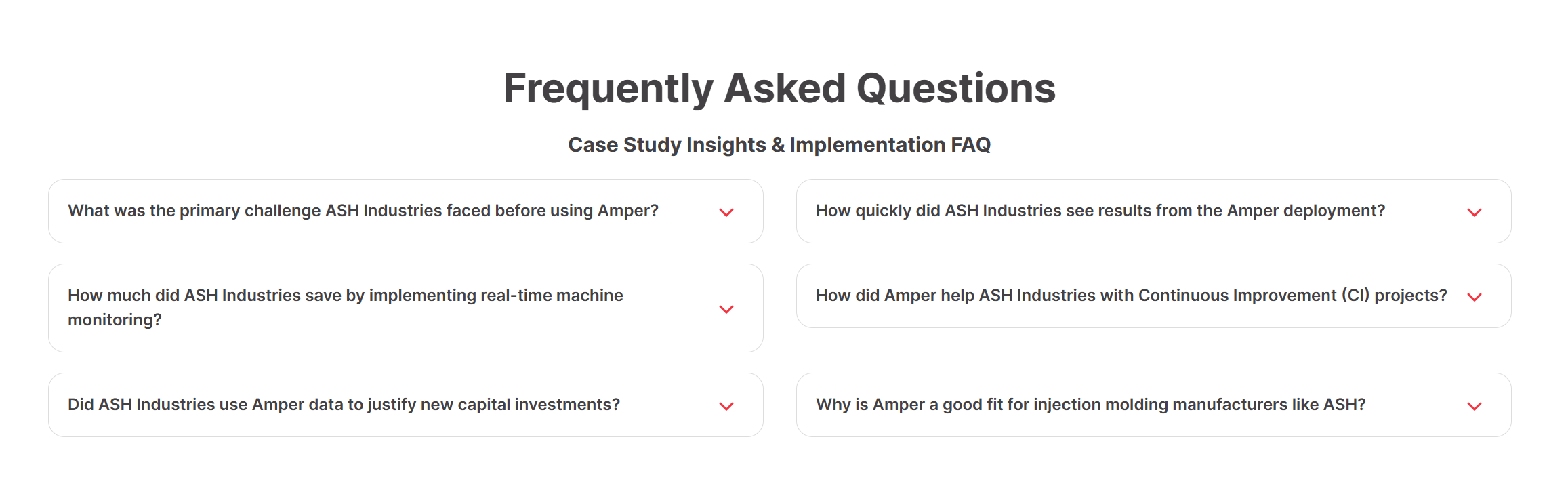
The case study ends with six FAQs, covering the customer’s challenges, deployment timeline, financial benefits and other topics. They help prospects find the information they need and increase the case study’s chances of appearing in AI-generated answers to buyers’ questions.
What you can learn from this and do:
- Identify questions prospects may still have after reading the customer story, then address them in a dedicated FAQ section.
- Include specific problems, actions or outcomes in your headings so that each communicates useful information, even when someone scans the page.
- Link to related content, products and services that help prospects continue their research.
What they could have done better:
- Show how the savings add up: ECI Software Solutions reports 3,000 annual labor hours saved and improved machine uptime, but doesn’t explain how those benefits contribute to its estimated $1.5 million in annual savings. Breaking down the calculation would help prospects evaluate the financial results.
- Expand the customer perspective: Stefen Clement, ASH Industries’ data and systems analyst, discusses how the company uses production data, but comments about the initial pilot, employee training and rollout would give readers insight into the implementation.
A critical supplier had just extended its delivery timeline from two weeks to at least eight weeks, putting a manufacturer’s production plans and customer relationships at risk. The timing couldn’t have been worse. Impermea Materials, which makes specialty coatings, had just moved from Boston to North Carolina to meet increasing demand.
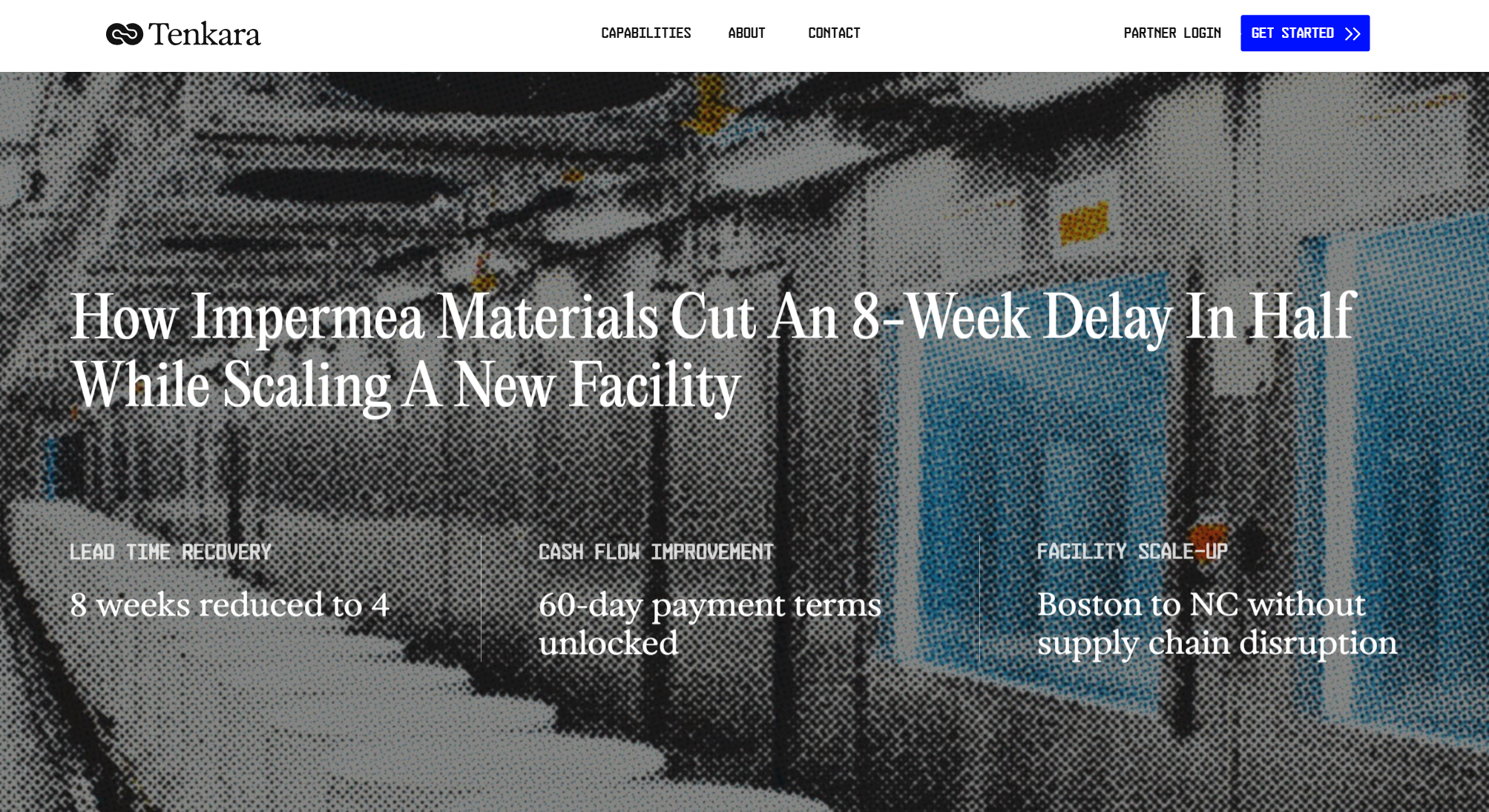
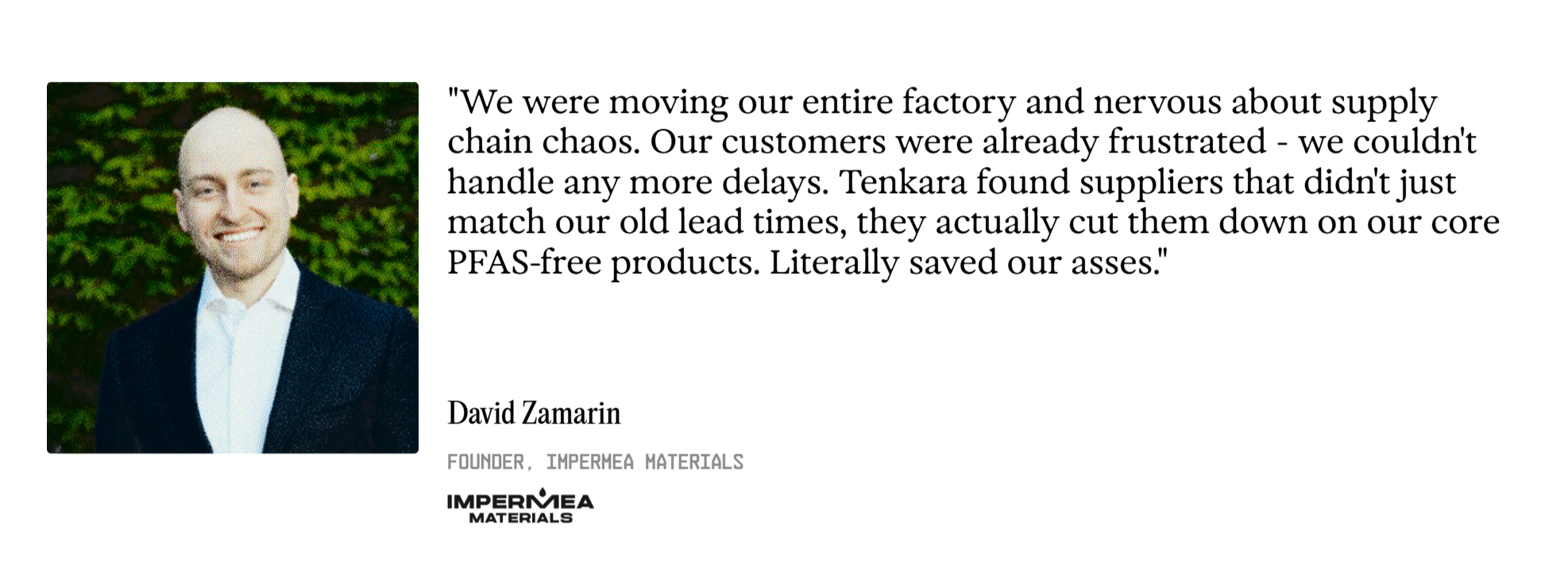
The story’s most memorable moment comes when the original supplier calls with additional bad news: Delivery will take 10 to 12 weeks. But Impermea founder David Zamarin already switched to another supplier. He recounts telling the original supplier that his company had moved on, only to hear the supplier ask what it would take to win back the business.
What you can learn from this and do:
- Ask customers to describe turning points when unexpected developments changed their plans, decisions or negotiating position.
- Have customers recount important conversations, including what each person said, how they responded and what happened next.
What they could have done better:
- Explain how Impermea chose its replacement supplier: Tenkara identifies three qualified alternatives, including two that could deliver within four weeks. But which supplier did Impermea select, and what tipped the decision?Those details would help prospective buyers evaluate their own supplier options when facing similar challenges.
- Tone down the drama: Phrases such as “8-week disaster into a 4-week miracle” and “from bottlenecked to bulletproof” exaggerate an already interesting story.
What makes an effective B2B case study?
An effective B2B case study helps prospective buyers picture how your company could help them solve business problems. It gives them a clear understanding of the customer’s experience, the work involved and the results.
Every case study should include five elements:
- The customer’s challenge: Explain the problem, why it needed attention and what was at stake.
- Your company’s solution: Describe your approach, the work you performed and how it addressed your customer’s needs.
- The customer’s results: Share specific outcomes, including before-and-after figures when available, so buyers can assess the improvements.
- The customer’s perspective: Include firsthand observations about difficult decisions, unexpected developments and lessons learned so prospects understand the customer’s experience and your company’s contributions.
- A clear call to action: Give interested prospects a logical next step, such as exploring a relevant service or contacting your team.
How to create B2B case studies in 12 steps
Ready to tell your own customer success stories? The details that make a story memorable often emerge when you ask thoughtful questions, listen closely and follow up on unexpected answers.
Here’s a 12-step process for finding promising stories, gathering the information you need and turning it into content prospective buyers will want to read:
1. Identify promising customers
Start with customers whose experiences demonstrate your company’s capabilities. Look for significant business problems, measurable improvements, unusual circumstances and projects that address your prospects’ needs. A recognizable customer name can attract attention, but a lesser-known business with a compelling story may be an excellent choice.
2. Choose your case study formats
Decide how you’ll present the story before approaching the customer. A written case study may be your primary piece, but you can also turn the material into sales slides, LinkedIn posts, email content and other marketing assets. Plan these formats early so you can gather the right information during the interview. For ideas, see How to Repurpose 1 Case Study Into 5 Marketing Assets.
3. Invite the customer to participate
Explain why you want to feature their experience and what the story will cover. Be specific about the information you’d like to discuss and whether you’ll need interviews, photos, video or supporting documentation.
4. Establish expectations early
Outline the customer’s time commitment, who needs to participate and how the review and approval process will work. Confirm any confidentiality restrictions and discuss whether the company can share performance data, employee names, quotes and images.
5. Research the customer and project
Review the customer’s website, industry, business challenges and relevant project records before the interview. Talk with your internal team to understand the work and identify areas that need clarification. Reserve the interview for questions that require the customer’s firsthand experience and judgment.
6. Prepare questions and share them in advance
Ask about the original problem, its business consequences, the decision to seek help and the results. Include questions that encourage specific examples: What happened when the problem first appeared? What alternatives did the customer consider? What would have happened if the company hadn’t addressed the problem? Request supporting before-and-after figures and documents ahead of time so interviewees can prepare.
7. Schedule conversations with the right people
Interview someone who experienced the project firsthand so they can explain the challenges, decisions and results. Depending on the story, you may also want perspectives from employees who implemented the solution or use it in their daily work. Allow enough time for thoughtful answers and follow-up questions.
8. Interview for the story behind the results
Listen for revealing details about decisions, setbacks and unexpected outcomes. When someone mentions an interesting development, ask what happened, how they responded and what came next. Ask how the experience affected employees, operations and customer relationships.
Record interviews with permission and transcribe them so you can verify quotes. Confirm important figures, including how the customer measured improvements, and whether the numbers represent completed results or projections.
9. Write and design the case study
Lead with the customer’s business problem and important results. Explain how your company helped, using customer observations, concrete examples and supporting evidence to tell the story.
Use descriptive subheads, relevant images and graphics to help readers follow the narrative. Verify names, titles, quotes, technical details and results as you prepare the content.
10. Obtain written approvals
Explain the review process, give the customer a clear deadline and identify who needs to approve the content. Confirm permission to use the company’s name, logo, photos and customer quotes. Let reviewers know that you may edit comments for clarity while preserving their intended meaning.
Obtain written approvals from the appropriate contacts before publishing.
11. Publish and promote the story
Share the finished case study through relevant marketing and sales channels, such as your website, email campaigns, LinkedIn and sales presentations. Give the customer the link and suggested social copy so their team can share it, too.
12. Start your next case study
Keep a running list of potential candidates and check in with account managers or project teams for new opportunities. Revisit previously featured customers when additional results or developments warrant an update. A collection of case studies spanning different industries, challenges and services gives your sales team examples that are relevant to different buyers.
What if customers don’t want you to identify them?
Some customers may hesitate to participate in a case study because they don’t want their company name, employee quotes or business results made public. Before accepting an anonymity request, ask what’s behind their concerns. They may worry about revealing sensitive information to competitors, need internal approval or simply be unfamiliar with the process.
Once you understand their objections, look for a compromise. For example, the customer may agree to disclose its name while keeping financial results confidential or allow quotes attributed only to an employee’s job title. If identifying the company is off-limits, you could describe it by industry, size or location, such as “a global financial services firm.”
If the customer insists on anonymity, consider whether the story is worth pursuing. Without a company name or identifiable sources, you’ll need specific, credible results and enough detail to establish the customer’s circumstances. If the evidence is limited, consider another candidate.
Give your customers a story worth sharing
Your next case study could begin with an impossible deadline, a production bottleneck or a conversation nobody saw coming. The details you choose and the customer’s firsthand account can help prospects recognize problems they’ve experienced in their own businesses.
Buyers are looking for evidence you understand their challenges and have the expertise to address them. A well-written case study gives them something concrete to consider as they evaluate potential partners.
Frequently asked questions
Look for customers who faced problems that are relevant to your prospects and are willing to discuss their experiences. Prioritize those who can provide specific examples, credible results and firsthand observations.
Include measurable outcomes such as cost savings, revenue growth, reduced downtime or productivity improvements. Provide before-and-after figures when available and explain how the customer measured the results.
Customer quotes aren’t mandatory, but firsthand observations add credibility and help readers understand the customer’s experience. Choose quotes that reveal specific challenges, decisions or results.
Aim for enough detail to explain the challenge, solution and results without overwhelming readers. The project’s complexity and available evidence should determine the length.
Related articles
Editor’s note: We originally published this article on April 10, 2024. We’ve updated it with five new B2B case study examples, fresh storytelling insights and a revised 12-step guide to creating customer success stories.